GalsenAI

Scientific excellence

Artificial Intelligence Olympiads

The national mechanism for selecting the secondary-school students who will represent Senegal at the International Olympiad in Artificial Intelligence.

The international competition

The International Olympiad in Artificial Intelligence

The International Olympiad in Artificial Intelligence (IOAI) is an international scientific competition for secondary-school students. Created in 2024, it follows in the tradition of the International Olympiads in Mathematics, Physics and Informatics.

It allows participating countries to identify and showcase their talent in artificial intelligence, around skills such as algorithmic reasoning, machine learning and complex problem solving.

In three editions, the Olympiad has grown from 32 to 108 participating countries and territories, and now counts more than 130 accredited countries and territories. GalsenAI is the accredited organisation coordinating Senegal's participation.

  • 32

    2024, first edition in Bulgaria

  • 61

    2025, second edition in Beijing

  • 108

    2026, third edition in Astana

The national programme

Senegal's National Olympiad in Artificial Intelligence

Until 2026, despite growing interest in digital technology and artificial intelligence, Senegal had no formal national framework for identifying and selecting its best secondary-school students in AI according to international standards. This gap limited both the visibility of national potential and young Senegalese talent's access to global scientific competitions in the field.

Establishing Senegal's National Olympiad in Artificial Intelligence (NOAI) answers this structural need by creating the country's first national mechanism for selecting AI talent at secondary level.

First participation

Senegal at IOAI 2026

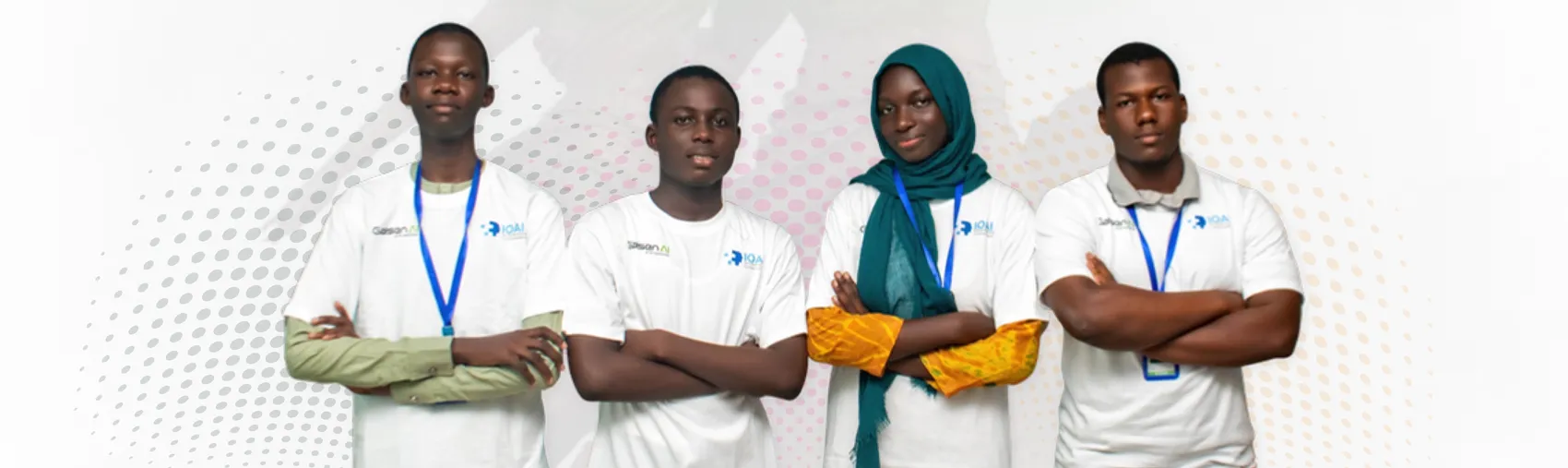
First national selection cycle, and Senegal's first official participation in the IOAI. Four secondary-school students competed directly in the main competition in Astana, without going through the GAITE support programme.

Les quatre élèves de la délégation sénégalaise, en t-shirt GalsenAI et IOAI, badges au cou, alignés face à l'objectif.
Senegalese students competing
4 Senegalese students competing
participating countries and territories
108 participating countries and territories
Competition venue
Astana, Kazakhstan
The full record of this cycle

Vision and objectives

A national benchmark for excellence in AI

NOAI aims to establish a national benchmark for excellence in artificial intelligence at secondary level, consistent with the standards of the international scientific olympiads.

Immediate objective

Second national selection cycle, which will name the Senegalese team for the fourth edition of the IOAI. It builds on the lessons of 2026: short intensive preparation gives way to a year-long track, begun as soon as the first candidates are selected.

The International Olympiad in Artificial Intelligence
4th International Olympiad in Artificial Intelligence
Singapore
4 to 10 July 2027
Co-hosted by AI Singapore (AISG) and Nanyang Technological University (NTU).

Medium and long-term objectives

  • Foster a culture of excellence, merit and fairness in artificial intelligence across the whole national territory.
  • Strengthen the national educational and scientific ecosystem by building a pool of young talent trained in the challenges of AI.
  • Establish Senegal durably within the global movement of scientific olympiads in artificial intelligence.
  • Prepare future generations for the country's strategic technological challenges.

Selection process

Timeline of the current cycle

Every round of the selection, its dates and how it unfolds. The timeline is updated as soon as any date changes.

  1. October 2026

    Registration opens

    Applications open, with a nationwide awareness campaign in secondary schools.

  2. October to December 2026

    Training and preparation

    Sessions open to every registered candidate: Python, algorithmics, problem solving, mathematics and an introduction to AI.

  3. January 2027

    Phase 1: Qualification

    First selection round, online, covering logical reasoning, algorithmics and problem solving.

  4. February 2027

    Phase 2: Assessment

    Assessment of programming, algorithmics and problem-solving skills.

  5. March 2027

    Phase 3: Advanced selection

    Rounds designed to identify the best candidates for the final phase.

  6. April 2027

    Phase 4: Final and bootcamp

    The best candidates gather on site: final rounds, intensive training and formation of the national team.

  7. May 2027

    National team preparation

    Deeper work on machine learning, deep learning, natural language processing, computer vision and problem solving.

  8. May 2027

    Subject to confirmation

    African AI Olympiad

    Possible participation in an African AI Olympiad, as a preparation and exposure step ahead of the international competition.

  9. June to early July 2027

    Final preparation

    Mock rounds, At Home Tasks, individual and team training, Team Challenge preparation and familiarisation with the competition platforms.

  10. July 2027

    IOAI 2027, Singapore

    The Senegalese delegation takes part in the fourth International Olympiad in Artificial Intelligence.

  11. August 2027

    Review and reporting

    Programme evaluation, lessons learned and groundwork for the next editions.

National team announcement : April 2027, at the close of Phase 4

How to participate

Eligibility and registration

Eligibility criteria

  • Be aged 20 or under as of 1 July 2027.
  • Be a secondary-school student in Senegal.
  • No geographic or institutional restriction: selection is open across the whole national territory.

How to register

Applications open in October 2026, alongside an awareness campaign in secondary schools across the country. The exact procedure will be published here when registration opens.

Registration opens
October 2026

Transparency

Selection criteria

How candidates are evaluated at each stage, and how the national team is determined.

From 2,000 students to a team of four

Each phase narrows the field. The figures below are the targets set for the programme; the detail of each round appears in the table that follows.

  1. Phase 1: Ignite

    2,000 students

  2. Phase 2: Orient

    1,200 candidates

  3. Phase 3: Advance

    24 finalists

  4. Phase 4: Immerse

    4 + 4

  • Phase 1: Ignite

    Spark curiosity and demystify AI. Online multiple-choice test on the EduSpace platform, covering general AI knowledge, logic puzzles and scenario questions. The test is open-resource: looking things up is encouraged.

    Expected results / Objectives More than 2,000 students targeted, with a pass rate above 60% expected.

  • Phase 2: Orient

    Assess research ability and understanding of ethical issues. Timed online exam on EduSpace, covering AI algorithms, basic Python logic and use cases.

    Expected results / Objectives 1,200 candidates.

  • Phase 3: Advance

    Test technical application in a controlled setting. Supervised on-site competition at 14 regional hubs. Candidates tackle a real-world data task, such as training a classifier to reach a given F-score.

    Expected results / Objectives The top 24 students (2 candidates for each of the 14 regions).

  • Phase 4: Immerse

    Final selection and intensive preparation. One-day on-site bootcamp in Dakar, built around scientific and practical rounds in the IOAI format.

    Expected results / Objectives Four team members and four reserves.

Publication of results

The results of each round are communicated individually to the candidates, at the end of the compilation period that follows each assessment.

Composition of the national team

Under the NOAI model, a national team of four members and four reserves are named at the close of Phase 4.

Participation fees

What participation costs

Participation is free of charge at every stage of the selection process.

No fee is charged to candidates at any stage. The costs of the programme are borne by GalsenAI and its partners, drawing first on academic partnerships, in-kind contributions and the commitment of qualified volunteers.

In accordance with IOAI regulations, no institution or individual may charge payments or fees with the intent to profit during any stage of the selection process. Collection of nominal fees is permissible only if they are strictly to offset expenses related to accommodation, travel and the actual costs of the competitions, without any profit being made.

Past cycles

Previous participation cycles

Every cycle keeps its own page: the process actually used, the participants and the results achieved.

  • 2026

    NOAI Sénégal 2026

    First national selection cycle, and Senegal's first official participation in the IOAI. Four secondary-school students competed directly in the main competition in Astana, without going through the GAITE support programme.

    View this cycle

A question about the selection?

Any question about eligibility, the timeline or how the rounds unfold will get an answer. Write to us.

Last updated :